chiefs

In light of the MoD ordering the services to implement the 7th Pay Commission award for the Armed Forces with anomalies unresolved, what are the options before the Chiefs now?

Option 1 – Capitulation –  Accept the RM’s assurance.Likelihood – most obvious and most likely.Outcome – Battle of Anomalies continue – those from 4th Pay Commission are still plaguing us. The Chiefs careers will be unharmed. However, they may not be able to face their commands with a clear conscience. Long term damage to the morale of the armed forces is a given.

Option 2 – Defiance – The Chiefs can request for a meeting with the PM or the Supreme Commander to present their case. Likelihood – unlikely. Outcome – May or may not be favourable. However, the respect for them in the eyes of their commands will rise tremendously. Even if the outcome is not positive, impact on morale would not be as severe, since the faith in own seniors will rise. Career prospects of chiefs may or may not be in jeopardy. It’s notable that Admiral Mehta who took a stand over 6th Pay Commission went as ambassador while Gen Deepak Kapoor, his contemporary who meekly accepted Lt Cols in PB 3, is still unemployed.

Option 3 – Resignation – The three Chiefs can tender their resignation to the RM in protest. This can be either as an immediate step, or in case option 2 doesn’t have a positive outcome. Likelihood – Highly unlikely. Outcome – The Chiefs would demonstrate the seriousness of the grievances. May force the government to take them seriously too. A game of brinkmanship that may be taken further by others refusing promotion to replace them. The Chiefs themselves may or may not get any post retirement sops, but would rise to legend status in forces for perpetuity.


Posted in Military | Tagged , , , , , , , | Leave a comment

Beyond the headlines

Oh-My-Headline-300x248In today’s milieu of crisp sound-bites, newsbreak a minute and short attention spans, the struggle to capture eyeballs and mind space of readers and viewers has become fiercely competitive. We, as consumers of news have become increasingly laid back and lazy, preferring our brains to be spoon-fed thoughts and ideas the anchors or journalists find fit to feed us. On the other side of the fence, newspapers and television journalists have become more and more imaginative to ensure survival. They have also, alarmingly, shifted the definition of their own role from reporting news to ‘shaping opinions’ – as this tweet indicates.

I find this thought alarming for, if the reporters, anchors and editors see themselves in such a role, who is to decide WHAT that opinion should be on a particular issue. And to what extent does such a role affect the judicious reporting of facts without giving it a subtle (or not so subtle) slant to suit the side towards which opinion is sought to be shaped. Of course, it’s not really possible to lie or fabricate facts to achieve this, without leaving themselves open to legal action. So the next best option is to ‘twist’ them. Instead of ‘the truth, the whole truth and nothing but the truth’, we get half-truths, opinions dressed up as facts, and their biggest weapon of all – misleading headlines. Capitalising on the tendency of the average news consumer to restrict their reading to the headlines, the message purported to be conveyed is cleverly crafted into it. That the rest of the story may not really bear it out completely doesn’t matter. It’s never going to be read most of the times anyway.

As a test case, I took up a random page from the newspaper I subscribe to, the Hindustan Times (New Delhi Edition, Page 14, 14 August), to examine the headlines and see how far the stories bear them out.

“Expert punch holes in Modi’s PoK plan” as per the first headline under the by-line of @jayanthjacob He starts telling the readers that the idea is not new and previous governments have been down this path earlier (therefore all this praise that the PM is receiving for it is misplaced and unfounded). He then goes on to quote the experts who, as per the headline have allegedly perforated the plan into a sieve. Maybe Jacob and I have different understanding of what it means to punch holes into something, but I couldn’t find a single expert quoted list a single flaw in the plan per se. All I found them doing is agreeing that it’s a bold move, and the challenge lies in now putting it into action. To my mind, any plan has challenges in implementation, and when it comes to a foreign policy initiative of such complexity, this is no great revelation. But nor does it construe trashing the plan itself.

The second headline tells us, “Centre, state govt staff may soon have to wear khadi once a week to office”. The story by @meetuttam and Moushumi Das Gupta would possibly like to have us believe what an autocratic dictatorship that this government is turning out to be (we told you so) by passing such a diktat, which, obviously, the hapless government servants have no option but to comply with. Goes so well with the narrative of this government telling people what to eat, wear and do. That is the impression such a headline would leave someone who doesn’t bother to read the story with. Which is what, I suspect, 90% of the readers would do. Though if you do bother to do so, you will find that the Khadi and Village Industries Commission (KVIC) has written a letter to the central and state governments with this suggestion. Several state governments, including Uttar Pradesh, have liked the idea and have passed it on to their employees, it has NOT been made mandatory by any of them.

The third headline goes, “Cong legacy doesn’t figure in govt’s I-Day celebration plan”. It’s difficult to figure out whether this particular gem is deliberately misleading, or simply a result of lazy reporting without even basic research. It goes on to inform us that Union Minister Narendra Singh Tomar would be travelling to Allahabad to pay tributes to Pandit Madan Mohan Malviya. Ministers would also be travelling to the birth places of other leaders, including Jayaprakash Narain, K Kamraj and the poet Subramania Bharati to pay homage to them. All these had been active members of the Indian National Congress during the independence movement, and in fact Pandit Malviya and Kamraj have been presidents of the party. So how can the headline be justified? Unless the newspaper or it’s reporter are restricting Congress legacy to the Nehru-Gandhi dynasty, which actually doesn’t figure in the plans. Considering that in the past so many years it was completely the other way around, one wonders how many articles were written in the past about the Congress leaders mentioned above being ignored.

Lastly, a piece by @smritikak tells us “RSS to mark Akhand Bharat Diwas Today”. While you may be pardoned for giving in to images of jingoistic celebrations exhorting people to undo the partition and reclaim the whole of Bharatvarsha, if you are one of the few who do bother to read beyond the headlines you might feel let down. “We don’t believe in the merging of states, but there should be a meeting of people”, a senior functionary is quoted. Isn’t that also what the much hailed ‘Aman ki Asha’ talks about, as do people who want Pakistani artistes to perform in India and vice versa?

As educated, discerning consumers of news, we must therefore make it a point to look beyond the headlines to avoid being led like sheep by whichever school of thought your newspaper or TV channel subscribes to, our opinions ‘shaped’ like mindless minions that we are possibly imagined to be.


Posted in Media, Politics | Tagged , , , , | Leave a comment

The Great Indian Dream

It’s that time of the year when dreams of a few thousand are realized. And those of a few hundred thousand shattered. Declaration of results – from the Class XII boards to competitive exams like IIT-JEE and CPMT invariably throws up two types of stories in newspapers. First are the exhilarating success stories of toppers – images of garlanded youngsters being fed sweets by beaming parents. The second are heart rending tales of suicides by students who felt they didn’t ‘make the grade’. An unusual twist in the first type this year was the bizarre story of toppers in Bihar who weren’t even properly aware of the subjects they were supposed to be studying and topping in.
All of the above, including the Bihar story, point to serious flaws. Not only in our education system, which is marred by a huge demand and supply problem. But the basic flaw in our thinking as a society and as parents, which exacerbates this problem of scarcity. Undoubtedly, a seat in a premium engineering college is a worthy goal to be coveted and strived for. And there’s nothing wrong with parents nurturing and enabling such aspirations of their children. Problems occur when aspirations become obsessions, to the extent that failure to obtain the desired results becomes equated with abject failure in life.
Thus we have a parallel education system in the form of coaching classes – cramming factories dedicated to the great IIT or Medical dream. The pressure cooker environment that hapless children exist in during those critical years is illustrated by this poignant prayer scribbled by a child on the walls of a temple in the ‘Coaching Centre’ town of Kota.

Clipboard01

This is especially sad in today’s environment where liberalized economy and globalization has resulted in opportunities galore. Thirty years ago, job prospects available for my generation restricted our aspirations to a handful of conventional streams. And most of us from that generation probably still suffer from the hangover of those times, thus harbouring the same ambitions for our children. We don’t realize how much the world has changed for the better from our times. At least in terms of the wondrous opportunities available to our children. The chart below is an illustration, and this itself is by no means exhaustive.

career_guidance
There is therefore a need for adequate mechanisms for counselling parents and children at a suitably early stage, to expose them to the plethora of education and career options available. This needs to be coupled with ascertaining each child’s interests and aptitude, and charting out a viable path customized for him or her. Such mechanisms are already available in the higher ends schools in bigger cities, where ironically the parents and children already have a higher awareness level. There is an urgent need to take this awareness to parents and children in smaller towns and cities. Only then will we possibly be able to stop this mad rush for marks and seats in a handful of domains, and prevent young lives being sacrificed at the altar of parental ambitions limited by lack of knowledge.

Posted in Education | Tagged , , , , , , | Leave a comment

Browbeating of service officers by defence journalists


This is a follow up of a prior post on the issue of online intimidation by journalists, specially of serving armed forces officers. I was witness to a similar incident, where a pair of journalists ganged up upon someone, apparently a serving officer. It started when the officer objected to one of them linking recent statements of Gen VK Singh as minister to question his selection for army by the SSB. The journalist, instead of arguing the point raised, started mocking the questioner, and soon his colleague joined in taunting the officer. He even insinuated that the officer was being paid a ‘twitter allowance’ for his tweets.

01

Undeterred, the officer persisted with his original query.

01a


The journalist’s reply was a shocker – that just because the general had served in the army, he had no right to be in politics.

He then switched to personal attacks, even questioning the officer’s courage in battle. He continued mocking the officer asking him if he had ‘filled up his forms to be on social media’, and then even accused him of being an impostor.

02a

02b

A few veterans including self noticed this conversation and questioned the journalist’s assertions. Again, instead of debating his stand / views, he insinuated that I was being paid ‘twitter allowance’, and then proceeded to block me.


05

06

The whole episode raises serious questions about the conduct of such journalists vis à vis serving officers. The social media environment has resulted in every assertion and utterance of anybody being open to scrutiny and remark. It’s an undeniable fact that apart from politicians, journalists are probably the most ‘trolled’ group online. There is a large section of people who are openly abusive and insulting to them, and this must be quite trying on their patience. There is very little they can do to such abusers apart from ignoring / blocking them. However, there is a distinct trend amongst the defence journalist to turn around and browbeat service officers, even when they’re not abusive and ask perfectly reasonable questions. This, and the previous post on a similar exchange, are clear illustrations of this trend.

The question is, why do these journalists, otherwise helpless against even the most abusive of trolls, consider service officers soft targets for venting their pent up frustrations? By virtue of their beat, these defence correspondents get frequent opportunities to interact with senior officers. While visiting units and formations to cover stories, they are treated with utmost respect and courtesy, with junior officers even being deferential to them (as they are with all guests). This possibly creates in their own mind a false sense of their own position being relatively higher up in the military hierarchy. Thus the obvious sense of outrage and contempt when their views are questioned online by a relatively junior officer.

Being familiar with the military environment, they are aware that if they report an alleged transgression by an officer to the highest headquarters (accessible to them due to their professional role), the officer concerned is likely to get in some amount of trouble. Although there are no rules prohibiting officers from being on social media and expressing their views (except on service and other proscribed matters), to a young officer serving a unit, a complaint of alleged misconduct coming down the chain of command all the way from Army HQ via intermediate formations would mean a lot of harassment, irrespective of the veracity of the charges. It is this fear that is being exploited by these journalists.

It is nobody’s case that service officers, or anyone for that matter, should be allowed to get away with being abusive or threatening online. Yet, it is also not in order to suppress their rightful freedom of expression just because they are part of a disciplined organization and respect rules. It is a pity if the adherence to the same rules is being used to threaten and browbeat them into silence, even if the issue raised by them are perfectly reasonable and nothing to do with security or service matters.

It is for the organization to take cognizance of such insults being heaped upon it’s officers and take steps to prevent their recurrence. This can include amplifying the current orders to mention, in addition to what serving personnel can’t do online, what they are permitted to do. We can take a page from similar orders for the US forces which are more elaborate, as under.

usp

In addition, the organization should also look at discouraging such conduct by journalists who derive their sense of power from their accreditation to the organization itself by blacklisting defaulters. And while importance of good relations with the media is understood, the organization should realize that any wilful disrespect to one of it’s own members is a disrespect to the organization, and take strong steps to prevent sundry people from walking all over their officers.

Posted in Media, Military | Tagged , , , , , , | Leave a comment

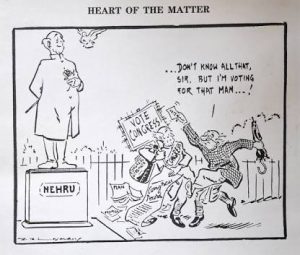
The Nehru Row

image
A spate of articles extolling the virtues of Nehru and castigatingng those criticizing him have appeared in the past few days. On the other hand, social media is flooded with posts deriding him and trashing his legacy. My take on the issue is that his contributions can’t be denied. Unlike his great grandson, he put advantage of birth in a leading political family to good use, working with intelligence and a vision. But the reasons behind questions being raised about him now are-

1. Dynastic rule with sycophantic followers resulted in his deification. So his greatness was tom tommed at the expense of ignoring or even downplaying the contributions of other, equally great men. It also resulted in any narrative of his contributions and legacy being completely subjective, without scope for any criticism of shortcomings that can’t but accompany anyone’s strengths.

2. Systemic repitition of this sanitized narrative of greatness in curricula and government communications resulted in it being implanted in the minds of successive generations.

3. Now, when there is an attempt to balance the scorecard by talking about the contributions of others, and also daring to attempt a critical evaluation of Nehru’s tenure as Prime Minister to mention shortcomings, it appears blasphemous to those conditioned to the sanitized, deified image of Nehru.

As a result, people at either ends of the ideological spectrum are taking extreme stances. So, depending on which side you are, Nehru was the cause of all that ails India today or a messiah above criticism. A dispassionate look, however, reveals that he was undoubtedly a tall leader of his generation. He had a definite vision for the country, and while his intentions can’t be faulted, a lot of his decisions were ill judged or ill timed. Also, there is no denying that there was no leadership vaccum at the time he took centre stage. There were quite a few of equivalent stature and competence who, given an opportunity, would have done an equal or better job. And quite a few of them did contribute immensely in their own capacity. The critical role played by Sardar Patel in unifying the country, and Lal Bahadur Shastri’s performance during his short tenure as PM, including his handling of the 1965 war, are just two examples.

To be true to our history, and for future generations to be able to derive the right lessons from it, its important to acknowledge the others and give them their rightful place in its pages. Alongside, it is also important to be cognizant of Nehru’s shortcomings and failures, without either taking away from or overly exaggerating his greatness. Thus people at either ends of the argument need to adjust and accomodate, moving towards a more realistic understanding. 

Posted in Politics | Tagged , , , | Leave a comment

Who’s Tweeting What – Modi Vs Kejriwal

Clipboard

Having followed both @narendramodi and @arvindkejriwal on twitter for a while, I noticed a distinct pattern to the way they each tweet. To confirm my impressions, I did a detailed analysis of their tweets over a period of the past 50 days (1 Apr to 20 May 2016) and tried to broadly group them into different categories. For ease of comparison, I tried to make the categories as similar as possible. Wherever this was not possible, I tried to group them into bigger categories which would be common (For example – Government Business). And since the volume of tweets over the fixed period were also substantially different – the PM tweeted almost twice as much as the CM of Delhi – I converted the number to percentage for comparison.
The resulting compilation threw up some very interesting data that gives a great insight into the thought process and leadership styles of the two leaders. It also gives a fair idea about what they’re preoccupied with. The detailed comparison is as per the table below, followed by some observations I have had.

Clipboard01

Observations
1. The highest percentage of tweets by Arvind Kejriwal are ones attacking / criticizing others (44%), and by Narendra Modi are about government business (50%).
2. Therefore, the former spends far more time in attacking others while the latter spends more time talking about his work.
3. Both devote almost an equal proportion of their tweets to compliments. However, the PM’s complimentary tweets are more varied, and include festival greetings for almost all denominations of the country. Three of Arvind Kejriwal’s tweets are self-congratulatory.
4. Just 27% of Arvind Kejriwal’s tweets are about his government’s activities, as compared to 50% by the PM. Apart from attacking others, he also tweets about affairs of other states. Some of his tweets are also offered as explanations / self-defence to criticism. While the PM also faces quite a lot of criticism, this is not reflected in his tweets.
Conclusions
While the readers are invited to draw their own conclusions after studying their data, my takeaway from this is that Arvind Kejriwal should spend less time in attacking other people, and focus more on the governance of Delhi for which he has been elected.

Posted in Politics | Tagged , , , | Leave a comment

Biting the Tail

ttt

Based on the Defence Minister’s directions to cut down on flab in a bid to reduce the salary bill and utilize the savings towards modernization, the Army HQs has ordered a study to reduce the ‘teeth to tail’ ratio. This means reducing the logistics elements (‘tail’) in proportion to the combat elements (‘teeth’) amongst the overall population of the uniformed force. It is undoubtedly a good idea. However, it’s also true that there have been several similar studies in the recent past, as a result of which the Army has already been trimmed to the bones. Because of the savings from the implementation of these studies, quite a few new combat units were raised through internal offsetting of manpower with no overall accretions.

In order to identify the ‘flab’ still remaining, there’s a need to widen the search beyond the uniformed forces to scrutinize the entire salary bill of the Ministry of Defence. Apart from the approximately 15 Lakh uniformed personnel, the ministry pays a large number of civilians. These are personnel from departments / organizations like DRDO, Ordnance Factories, Defence Estates, Defence Accounts, MES and Armed Forces Headquarters staff. As per the Census of Government Employees 2011, this figure has grown from 3.65 Lakhs in 2008 to 3.75 Lakhs in 2011. There has been virtually no corresponding increase in the strength of the uniformed personnel in the three services. This represents a substantial number – 25% – vis a vis the strength of the uniformed forces, and therefore a major chunk of the defence salary bill. In monetary value this share is disproportionately greater than 25% because of a higher ratio of senior posts amongst this vis à vis the armed forces. For example, it includes 121 Apex grade / HAG civilian personnel receiving the highest salaries as compared to 24 at the corresponding grades (Chiefs / C-in-Cs) in the armed forces. The tail is thus not only abnormally larger than the body, but also top heavy.

Any study carried out by the Army would have a restricted scope in identifying the ‘teeth’ vs ‘tail’ from within the uniformed organization itself, translating this directly into the combat and logistics elements respectively. However, when viewed in the larger perspective to include the civilians paid out of defence estimates, the paradigm changes. It emerges that as compared to the 3.75 Lakh non-combatants, even the logistic personnel of the army are engaged in ‘core’ function of combat. Each one of them is a trained soldier, with a weapon to his / her name, and capable of taking up front line combat duties if and when required. As frequently happens when personnel of the logistics services are posted in Rashtriya Rifles or even deployed as part of their own units in Counter Insurgency environment. Also, these include elements whose roles are so specific to war time they may appear superfluous in long spells of peacetime soldiering. A prime example of this is the Animal Transport units which hold mules for supplying far flung posts in mountainous areas. An earlier study had recommended these to be done away with. While this was being implemented, the Kargil War broke out, which highlighted the inescapable requirement of these units in such conflicts. As a result, the decision was reversed and these units retained. On the flip side, there are quite a few functions amongst the non-uniformed portion of the ministry which can, or rather need, to be trimmed. For example, while manufacture of armaments and ammunition by the Ordnance factories is necessary, it’s difficult to justify government factories making clothing, shoes and other such items which can easily be sourced from trade.

Indian-ordnance-Factories-6911-Junior-Work-Manager-Posts-2016

The way forward for a truly significant reduction in teeth to tail ratio is to look at the uniformed forces, including the logistic elements, as the teeth, and the civilians paid out of defence estimates as the tail. Such a study would necessarily have to be conducted under the aegis of the ministry, with requisite representation from the affected organizations including the armed forces. It would have to be monitored at the political level to ensure organizational affiliations don’t cloud rational judgement and block justifiable reductions. Only then would it be possible to meaningfully achieve the Defence Minister’s objective of reducing the salary bill of the Ministry and utilize the savings for modernization of the forces.

Posted in Military | Tagged , , , , , , , | 3 Comments

Diesel Smoke

scan0018-300x223

The unique bond between a man and his steed is as old as time itself. More accurately, it goes back to the time when man first domesticated animals and, in addition to new source of food, found a better way to move around than walking. Very soon he realized that fighting from the back of a horse, camel or elephant gave him a distinct edge over unmounted opponents. The speed, reach and elevation of mounted soldiers became a war winning factor. Some horses are almost as well known as their illustrious riders. Alexander’s Bucephalus and Rana Pratap’s Chetak, are legendary for the bond they shared with their riders. By the beginning of the twentieth century, newer technologies resulted in living flesh and blood steeds being replace by mechanical ones made of cold hard steel. Yet, strangely, the steel mounts still seem to have a soul, one which bonds irrevocably with that of his rider.

The mechanical steeds of modern day may be a trifle more demanding and unforgiving than the unquestioning loyalty and devotion of their equine ancestors. Yet they have also been known to rise to the occasion in displays of almost intuitive sense of timing. They respond to prayers and entreaties, rising to impossible levels of endurance and resilience that would be difficult to attribute to merely a machine. How else can you explain a squadron commander’s tank in the middle of a corps exercise, with it’s gear shift linkages broken, completing the exercise with one crew member sitting on the engine deck shifting gears with a crowbar?

One such steel monster with a soul, and a mind of its own, was known to the world as ZX1638, (the military equivalent of its license plate number) or simply ‘Sohla Athatis’ (the digits as spoken in Punjabi ). It was the very first tank assigned to me (or was I assigned to it? It was never clear) on commissioning into my regiment. Being a troop leader in addition to a tank commander, I had two more tanks to call my own, but my own tank was special. After all, I expected to ride into battle on it, if and when it came to that. I couldn’t claim sole proprietorship for it, as there were three other claimants for its attentions – the crew consisting of the gunner, operator and driver. As ours was a pure ‘Khalsa’ squadron, all three of them were Sikhs – sturdy, rustic, with a sense of humour that was irrepressible as it was irreverent. The biggest upstart among them was Prabhjit – short, stocky with an indifferently tied turban, he was the driver and also my ‘sahayak’. This meant that both of us – Solah Athatis and I – were on his charge. Apart from being responsible for the tank’s tools and fuel accounting, he was answerable to the Squadron Senior JCO for me being present at all parades at the right time and in the right rig.

It was our job as it’s crew to keep Sohla Athatis battle worthy and ship shape at all times, and as a newly commissioned officer I was expected to be as much hands on as the rest of the crew. There were lists of daily, weekly, monthly maintenance tasks that had to be carried out, in addition to any running repairs that the 18 year old machine frequently required. A major part of our working day was thus spent on tending to the tank. Things went smoothly for a couple of months, without me having an occasion to worry about the roadworthiness of my tank or my own routine. Till Prabhjit went on a spot of short leave, leaving me and Solah Athatis in the care of a temporary replacement. I suddenly found it difficult to show up on parade in time – my uniform would be missing, or my motorcycle keys would be untraceable. But my problem of tardiness paled into insignificance before the larger issue that faced us. Sohla Athathis suddenly started ‘misbehaving’. The annual technical inspection was coming up in a couple of weeks, which meant all the tanks had to be re-painted, and put in a mechanically sound condition. Sohla Athathis was to be taken to the workshop a few kilometers away for carrying out some maintenance tasks, but the reticent tank refused to start. Everyone, from the most experienced driver in the squadron to the technician from the workshop tried to cajole, threaten and bully the obstinate machine, but to no avail. It’s air bottles were exhausted trying to start it pneumatically, and the batteries were nearly drained in attempts at electrical starting. Intriguingly, the mechanics couldn’t find any fault with any system, except for the fact that it just wouldn’t start.
parakram10
We had a troop conference to figure out what could be done. After much banter and lewd jokes, as was the norm for such momentous gatherings, the collective wisdom of the troop was to do nothing and await Prabhjit’s return. Since there was just about enough time between his rejoining and the inspection, we concentrated on getting the other two tanks ready. Then Prabhjit arrived, grinning from ear to ear and glowing with the special gleam that spending even a few days back home gives a soldier. We all watched in amazement as he got into the driving seat of Sohla Athatis and with a few deft strokes, managed to get the engine roaring within seconds. The matter was soon forgotten in the hectic run up to the inspection. Years passed, both Prabhjit and Sohla Athatis completed their respected service and left the regiment. Eventually the regiment itself got converted to newer, more modern tanks. Then I too hung up my spurs and moved on to the civvy street. But the special relationship between Prabhjit and his tank continues to intrigue me. To my mind there was only one explanation. It doesn’t matter whether the mount is flesh or steel. It’s the special bond formed between it and its rider which causes soul of the rider to reach out and wrap itself around the living or lifeless steed. Willing it to think it’s thoughts, act as per it’s cues. And conversely, the mounts also change the riders forever. A little bit of the sweat, blood and living breath of the steel monsters that I rode for 20 years remains with me to date. The whiff of diesel smoke mixed with dust, be it from a truck overtaking my car on the road, still triggers memories of nights spent sleeping on the comforting warmth of the engine deck in the middle of nowhere in the desert.

Posted in Military, Tanks | Tagged , , , | Leave a comment

Citizen Soldiers

increase_it_flexibility_by_leasing_it_assets

This post is a result of the 140 word tyranny of Twitter which, while well suited for one-liners and retorts, handicaps expressing of a complex idea coherently. I was trying to refute a view that serving soldiers of the armed forces are banned from expressing political views on social media, and after trying to argue my case via serialised tweets, decided that it called for a blog post instead.

Let’s get some basics sorted out first. The Indian Army is, and MUST remain, an apolitical organisation. No two ways or arguing about that. My book ‘Riding the Raisina Tiger’ is about a scenario where it ceases to remain such, and the consequences. However, that should not and does not mean that individuals who form part of the organisation also need to be bereft of any political views as individuals, or that they should be prevented from legal expression of those views in their individual capacities. This is part of their fundamental rights as citizens.

It is true that on joining the armed forces, an individual agrees to some of his or her fundamental rights being restricted. These are laid down in Army Act Section 21 , which accords the Central government “Power to modify certain fundamental rights in their application to persons subject to this Act.” Sub section (b) empowers the government to “make rules restricting to such extent and in such manner as may be necessary the right of any person subject to this Act to attend or address any meeting or take part in any demonstration organised by any body of persons for any political or other purposes.” There is therefore no restriction for them to have and express political opinions as individuals.

Since the Army Act dates back to 1950, much before the advent of social media or the internet, it does not cover the conduct of persons subject to it online. This gap is filled by instructions issued be service HQs covering the Do’s and Don’t for serving personnel while posting online. The are as under.
increase_it_flexibility_by_leasing_it_assets

So, in effect, there is no rule prohibiting armed forces personnel from expressing their personal political views on social media individually. And that, I believe, is the way things should be. For in the army of an independent democracy, the solider is also a citizen with voting rights. He therefore is expected to have a political opinion to be able to exercise his franchise judiciously. And in this day and age of feedback driven world, wouldn’t it be unfair both to him and to those who represent him to deprive him of the freedom of expression which would convey his opinion to the political class and allow the same to be an input in their decision making process.

That brings me to the disturbing fact that a large number of people suffer from this misconception, probably stemming from an idea of what they feel ‘ought to be’. They seem to associate, or rather mix up, the apolitical nature of the organisation with the political awareness of individuals who form the organisation. This point of view possibly originates from within the army itself, which was traditionally a colonial force with rules framed to suit the colonial masters. Ever apprehensive of a mutiny and aware that the army was the lynchpin of their ability to maintain their rule, it made sense for them to bar not only political activity amongst soldiers, but also discourage harbouring of any political thoughts or opinions at all. That was also the reason why traditionally soldiers were isolated in sanitized cantonments and discouraged to fraternise with civilian population of places where they were posted.

Post independence, this mindset was difficult to shed by senior officers themselves, having been brought up in such an environment, and therefore they continued to discourage political thought. This also suited the leaders of the nascent government, in whose minds the colonial regime’s fear of mutiny was replaced by dread of a political coup by the army. The fact that till recently, there was no concerted effort by either the military or the civilian leadership to ensure that soldiers got to actually exercise their right to vote , is demonstrative of this.

Today, almost seven decades after independence, things have changed in a couple of ways. The army has remained an apolitical organisation, having repeatedly proved itself in war and in peacetime turmoils. The spectre of a military takeover doesn’t haunt the political leadership (or at least, given the track record, it shouldn’t). Also, and significantly, the soldiers and officers today are more connected with the ‘outside world’ thanks to increasing awareness and availability of improved tools including mobiles, internet and social media. To say that a soldier of the 21st century would not have a political opinion would be naive. And to deny him the expression of the same, within the framework of existing rules, would be curbing his fundamental rights over and beyond what is laid down in the Army Act.

Enlightened democracies world over have rational and liberal rules in this regard. The policy in the US armed forces with regard to political activities by soldiers is illustrative.

increase_it_flexibility_by_leasing_it_assets

Not only are they explicitly allowed to express their “personal views or public candidates” but, unlike restrictions still in force in India, they are even permitted to “join a partisan or non-partisan political club and attend its meetings when not in uniform.” The riders to these are that they do so in their personal capacity, and as individuals not collectively as a group of soldiers.

It is time, therefore, to shed our outdated perceptions about what does and does not constitute an apolitical army. To put the record straight, it implies that while collectively and as an organisation participation in politics and expression of policial views are proscribed, there are no restrictions in doing so in an individual capacity.

Posted in Military, Politics | Tagged , , , | Leave a comment

FOE- Who Will Guard The Guardians?

With volumes having been spoken about Freedom of Expression in the past few days, its difficult to write about it without a wee bit of apprehension. Has everything that’s to be said on the subject already been said? Why bother adding to the terabytes of characters jostling for cyberspace propagating different points of view on the subject. But then, a few more kilobytes won’t make a difference, and at least I would get to exercise my own FOE. Will attempt to do so without going into the issues already discussed threadbare, but restricting it to personal experience over the past few days.I will start with the conclusion I have drawn first, and then go on to explain how and why I arrived at it. And that is – people who espouse the cause of FOE are no different from those who shout for lynching of someone because of what they said. This was driven home forcefully to me on social media over the last couple of days.

In the first instance, I expressed my opinion about the political dispensation that has prevailed in the country since independence. My view was that it was also ‘colonial rule’. The rigor of 140 characters imposed by twitter prevented me from expanding – that it may not have been political colonialism, but it certainly was ideological and economic. But before I knew it, I got a highly derogatory reply from someone who is (as I found out later on googling her) supposed to be an established journalist who has worked with several leading media houses. Reading my tweet, she had already slotted me as a semi-literate ‘sanghi bhakt’ from (what she seemed to consider) some downmarket Hindi medium school. Since she had asked, I told her where I had been educated, and the antecedents of my alma mater. She retorted by accusing me of lying and impersonation, but must have soon realized the veracity of my credentials. So she changed track and started threatening to send me to jail for stalking and sexual harassment. That was when my response to her caught the imagination of the twitterati, and it started getting re-tweeted and replied to with amazing speed. Having painted herself in a corner, and with the word spreading like the proverbial wildfire on twitter, she resorted to blocking me (and as I found out later, everyone else who retweeted my tweet).

increase_it_flexibility_by_leasing_it_assets

increase_it_flexibility_by_leasing_it_assets

The second instance did not involve me directly, but someone (possibly because of the visibility I had received in the above mentioned exchange) tagged me in an ongoing conversation between a senior journalist from a leading news channel and some serving and retired army officers. From what I could make out, the discussion related to a post on the channels website which described the two martyrs in the recently concluded Pampore encounter as JNU alumni. The officers were taking objection to this, as the affiliation of NDA alumni with JNU is a mere technicality – though we get a JNU degree, almost all of us have never even set foot on the campus itself. 

After a bit of back and forth, the journalist in question apparently stated intimidating one of the respondents, threatening to report him to the army authorities for his presence on social media despite being in service. He even tagged the official handle of Indian Army, claiming that the officer concerned was ‘accusing him of lying’ and being ‘insulting to journalists’. Subsequently, he sent the officer a Direct Message asking for his rank, name and unit, once again threatening to report him to none less than the Chief of Army Staff – a threat I have subsequently learnt that he has carried out.

increase_it_flexibility_by_leasing_it_assets

increase_it_flexibility_by_leasing_it_assets

increase_it_flexibility_by_leasing_it_assets

increase_it_flexibility_by_leasing_it_assets

This, to me, was objectionable at several levels.

The journalist implied that because the officer was serving, he did not have Freedom of Expression on social media. As someone who reports regularly on defence matters (and, I must add, is respected for his reportage), he should have known that this is not the case. Army officers have the same freedom as any other citizen, except for the fact that they are not allowed to post / comment upon any operational / service related matter, or post pictures in uniform. There is no law or army order stopping him from expressing his views about his alma mater, or his opinion about journalists, even it is not a very high one. 

Besides, having found his views objectionable, the journalist threatened to report him to the army authorities. He could do that because the person on the other side was from a disciplined force, and both knew that even if he was not really at fault, such a complaint was likely to cause trouble for him coming from a senior journalist whom the organisation would like to keep on their right side. Had the same incident involved, say, a young JNU student, would the journalist’s response have been same? Probably not, since such a threat would be inconsequential. 

I view both the above cited instances as wilful attempts at suppression of someone’s Freedom of Expression by using unfair intimidation. While soldiers entrusted with securing the country’s borders, journalists are the ones supposed to be fighting for Freedom of Expression. And they have been vocal in doing so for the JNU students who are currently under national scrutiny. Yet, when they are directly affected, as in the above two instances, there seems to be no walking the talk. In the course of their work, journalists get to interact and build relationships with people at the highest levels. Yet that should not lead them to treat everyone else with contempt.

“I disapprove of what you say, but I will defend to the death your right to say it,” shouldn’t this apply to soldiers and journalists alike. And as regards the young officer exercising his freedom of expression, I can only hope that someone in the authorities read this and see the incident for what it is, rather than throwing the book at him just to appease a journalist.

Posted in Media, Military | Comments Off on FOE- Who Will Guard The Guardians?